From the Normal Education Act to the Teacher Education Act
The implementation of nine-year compulsory education in 1968 led to an increase in the demand for secondary school teachers. The original Normal School Act only applied to the training of "primary school teachers" and was therefore unable to meet the needs of the changing times. Therefore, the Normal Education Act was promulgated in November 1979. The law established a system for training teachers and made appropriate adjustments in response to the supply and demand for teachers, thereby providing a clear framework for the development of teacher education.
Although the Normal Education Act laid the foundation for the development of teacher education in Taiwan, shifts in society and limitations within the system itself sparked debate among the education sector and non-governmental education reform groups. National Chengchi University Department of Education professors Huang Ping-Huang (Department of Education, Class of 1958) and Tsai Pao-Tien have criticized the outdated concept of a monopolized teacher education system. In February 1991, students from NTNU and National Kaohsiung Normal University jointly petitioned the Ministry of Education for the first time, calling for the relaxation of Article 17 of the Normal Education Act, which stipulated that "teacher trainees may not engage in work outside the field of education or pursue further education during their prescribed service period."
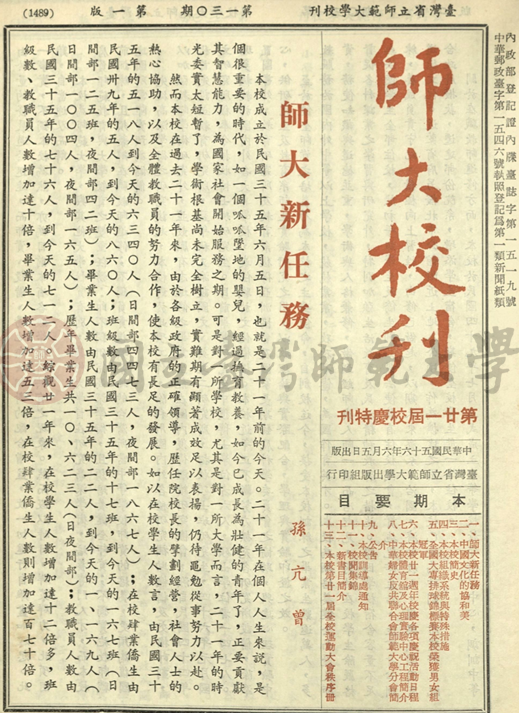
Huang Ming-Li, who graduated from the Department of Chinese, Class of 1985, recalled how the passage of the Normal Education Act most notably impacted him and his peers: the obligation to fulfill their required service after graduation. Otherwise, they would have to resign and repay the public funding they had received. Students who received four years of government funding were required to complete four years of service after graduation. If they served one year less than required, they had to repay one year's worth of funding; if they served two years less, they had to repay two years' worth, and so on.
"After the passage of the Normal Education Act, you had to fulfill four years of compulsory service after graduating before becoming free to pursue other work or further studies. If you wanted to seek further education or a higher degree, you had to resign and repay the money. But those who graduated two years before me, prior to 1983, weren't affected by the new law. They didn't have to repay any money even if they chose to further their studies after graduating."
"In college, there was a professor in my department who strongly believed that government-funded education was too conservative and overly dependent on government support. He felt that the teacher education system fostered too much homogeneity among students. According to him, the school should abolish the publicly funded tuition system and transition into a comprehensive university."
—Huang Ming-Li, Department of Chinese, Class of 1985
On April 10, 1994, non-governmental organizations such as the Teachers' Human Rights Association, the Humanistic Education Foundation, and the Jendo Education Society staged the 410 Demonstration for Education Reform to campaign for modernizing education. Their demands included the diversification of teacher recruitment and instructional materials. Non-governmental education reform groups not only organized marches and forums, but also collaborated with opposition legislators to monitor the legislative review of the Teacher Education Act.

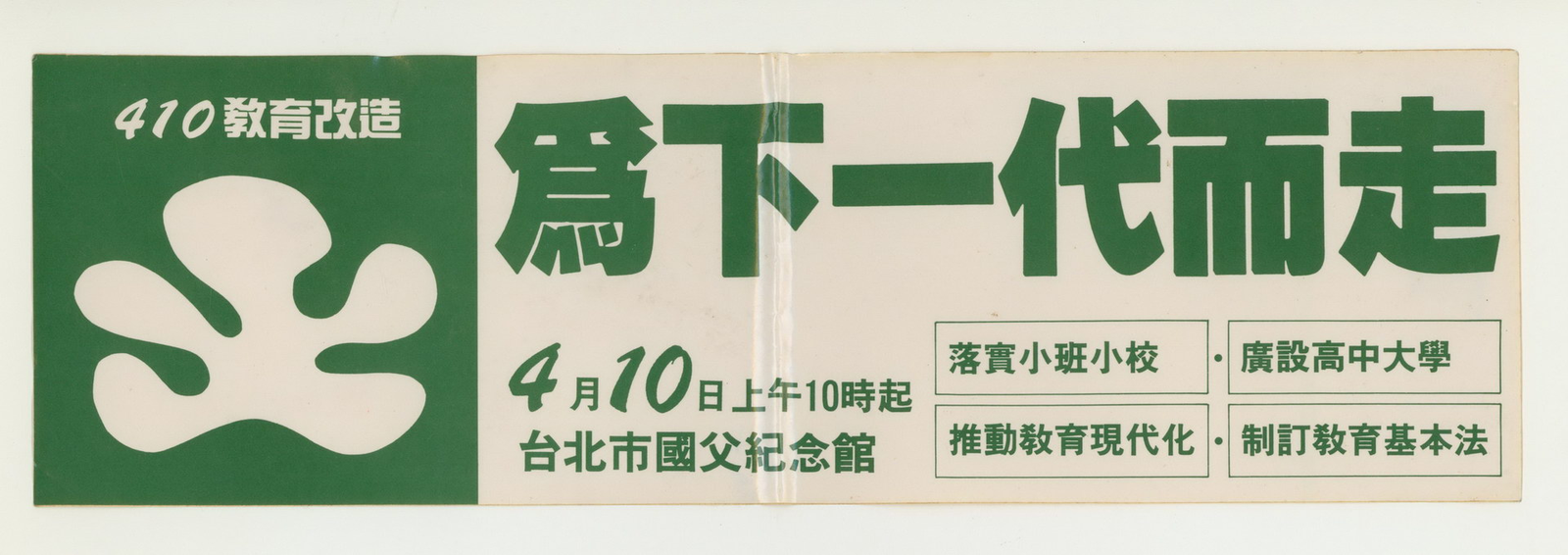
410 Demonstration for Education Reform (April 10, 1994. Courtesy of: National Museum of Taiwan History)