Teacher Education
In 1946, Taiwan Provincial Teachers College was designated as a training institution for secondary school teachers. Following the April 6 incident in 1949, Liu Chen, Chair of the Committee for Rectifying Academic Conduct and acting president of the college, placed greater emphasis on students' life education and civics education. The former involved flag-raising ceremonies and morning drills, freshman orientation, and daily routines managed by dormitory personnel. The latter fostered nationalism through initiatives such as strengthening education on Chinese language, history, and geography, as well as holding lectures on classical Chinese literature.
The College held an annual Teacher Education Promotion Week every March or April since 1948. Activities included on-campus speech contests, film screenings, concerts, school visits, poster presentations, sports galas, and science exhibitions. They were intended to convey the meaning and importance of teacher education and to inspire teacher trainees' dedication to national education.
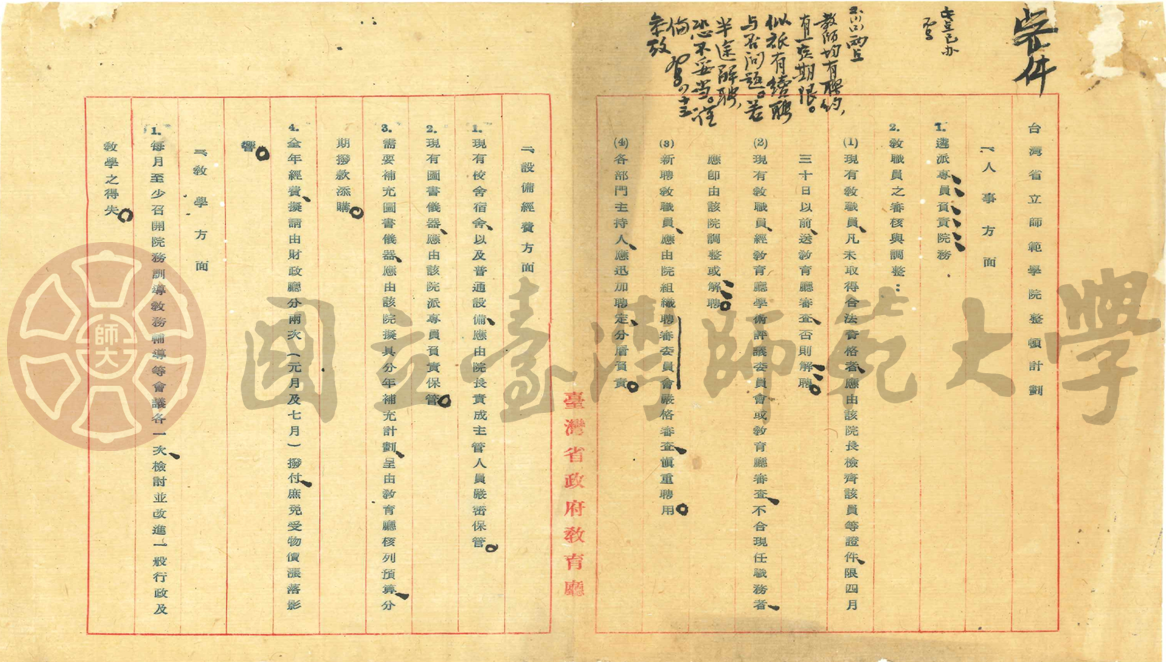
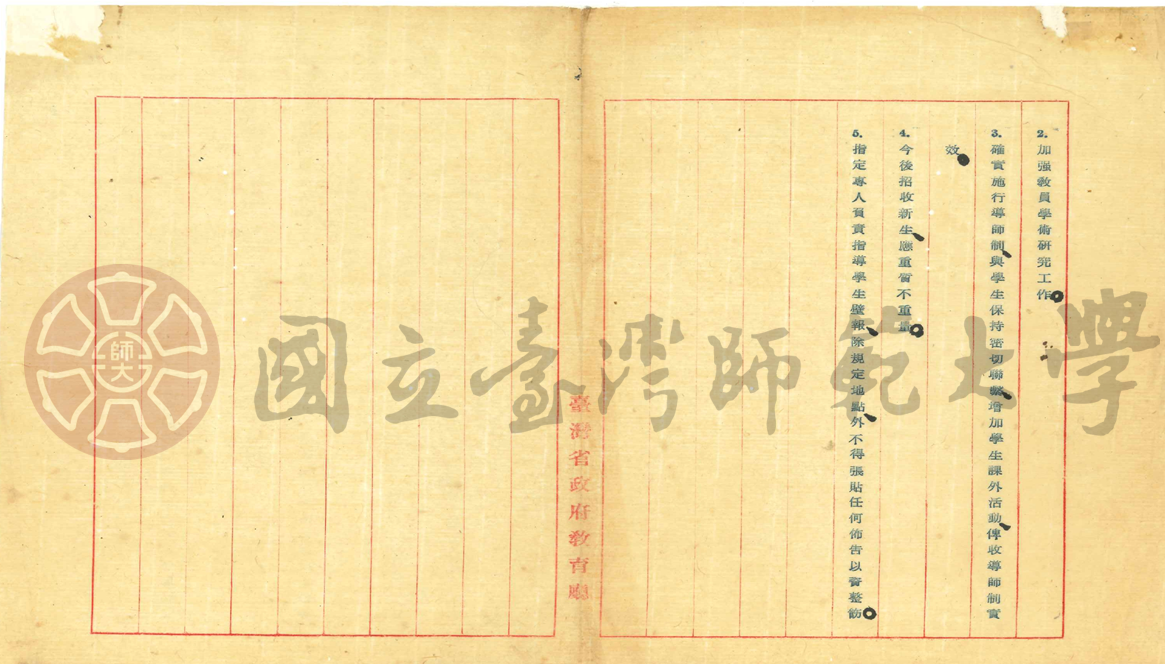
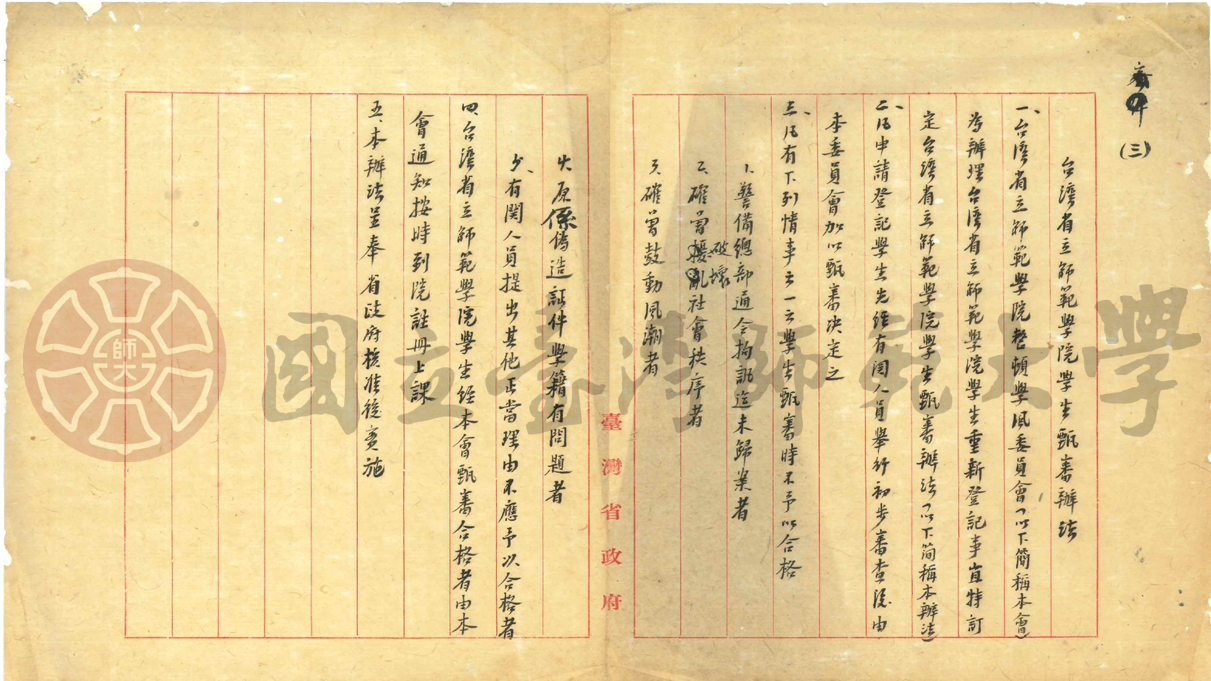
Official Document on the Rectification Plan of the Committee for Rectifying Academic Conduct of the Taiwan Provincial Teachers College
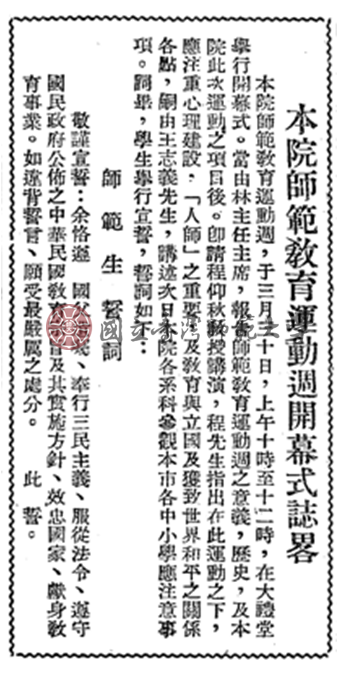
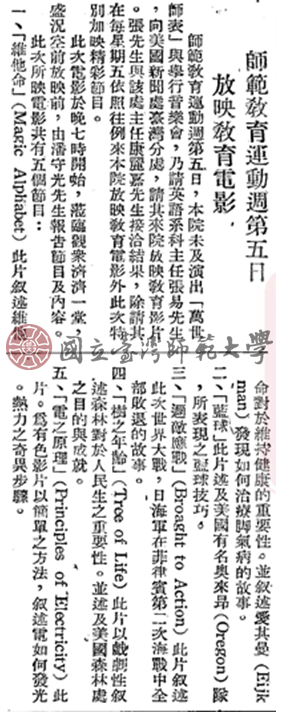
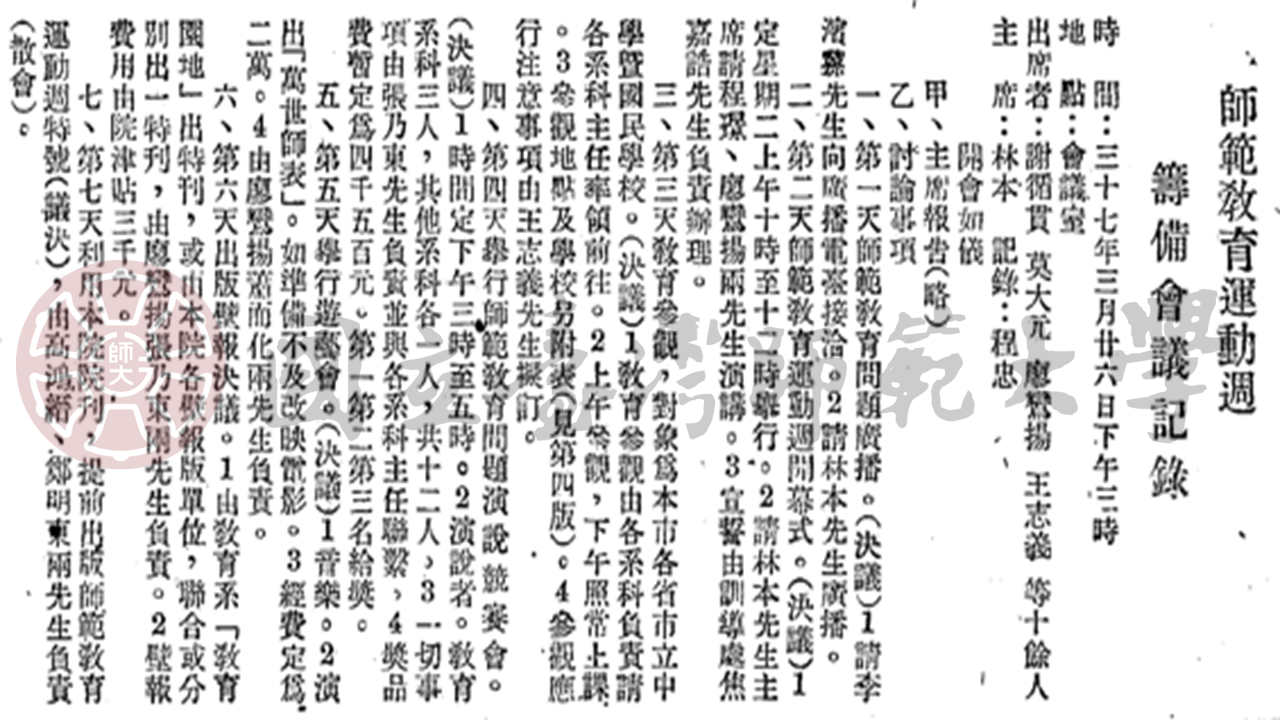
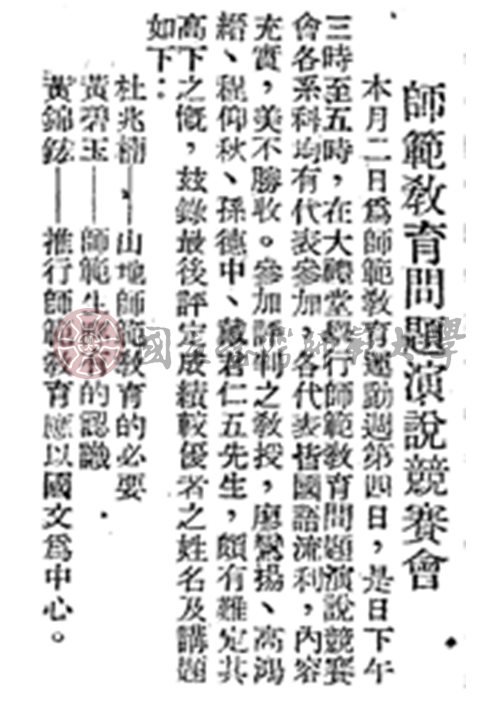
Brief Record of the Preparations for the Opening Ceremony of the Teacher Education Promotion Week (Taiwan Provincial Teachers College Journal, Vol. 2, 1948)
"Looking back, the time I spent studying at the college was truly wonderful. Almost all students lived on campus, with the exception of those with a home in Taipei City. They already lived in Taipei, so there was no need to live on campus. Everyone else stayed in the dorms. Those of us who lived on campus had to get up early for the flag-raising ceremony. We often overslept, which made it rather fun."
—Liu Kuo-Sung, Class of 1955, Department of Arts
Students who stayed on campus had to attend the flag-raising ceremony every day, while students who commuted had to arrive at school at seven o'clock in uniform for the flag raising ceremony every Monday. Those who commuted had a hard time with it and would sometimes oversleep, but he (Liu Chen) was very insistent on this. You had to get here at seven o'clock and you had to wear your uniform, no exception. Eventually, students got used to it as they gradually developed a routine, and actually became more spirited."
—Lin Liang (Tzu Min), Class of 1952, the Chinese specialized training course
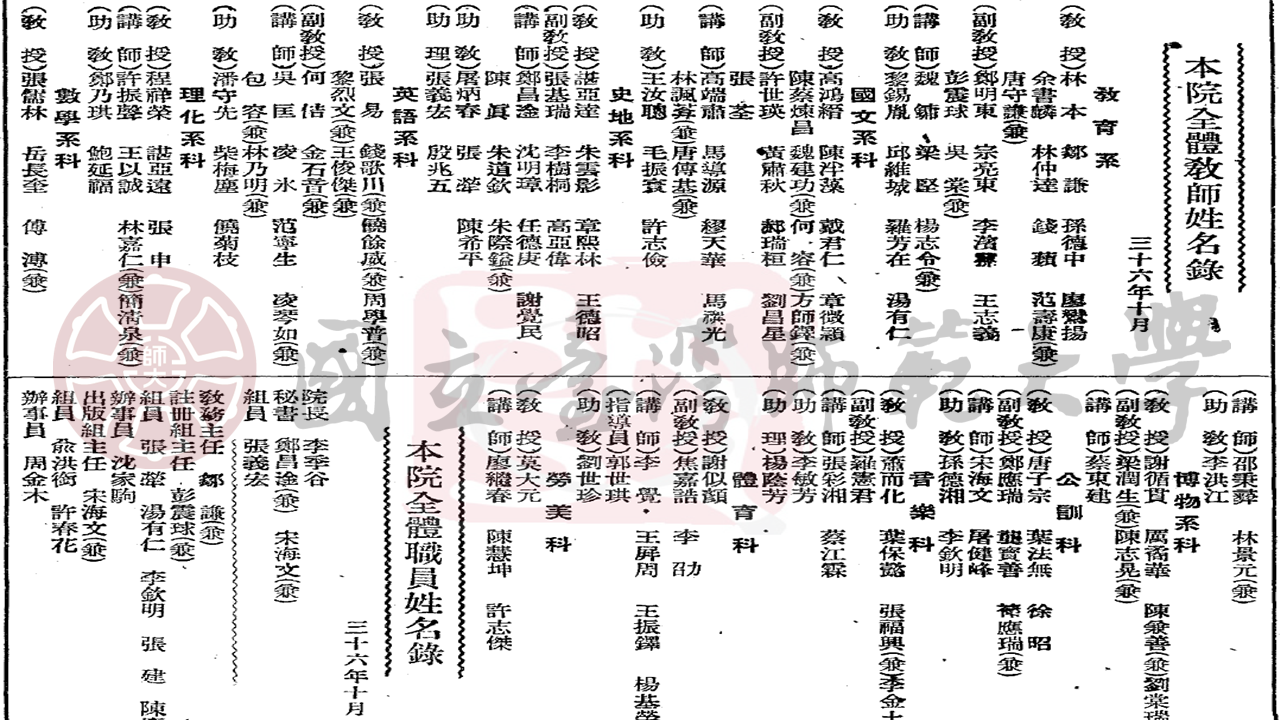
Faces of Faculty Members
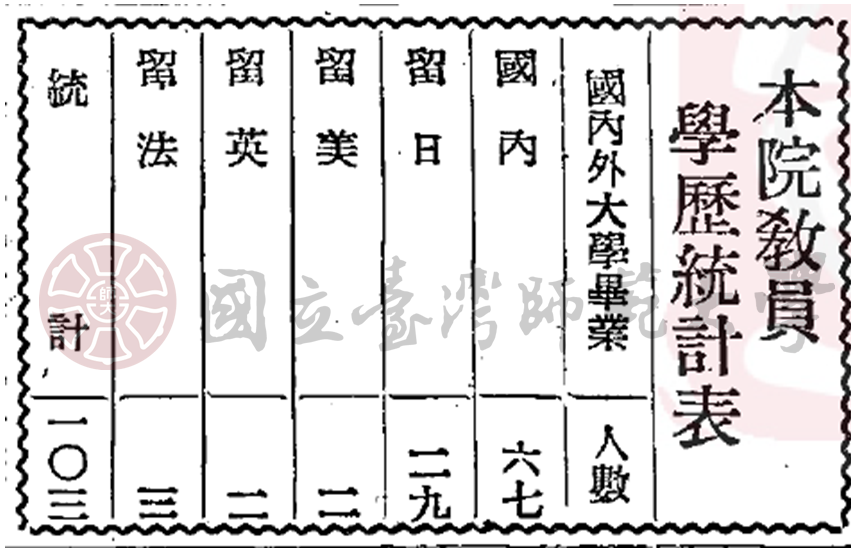
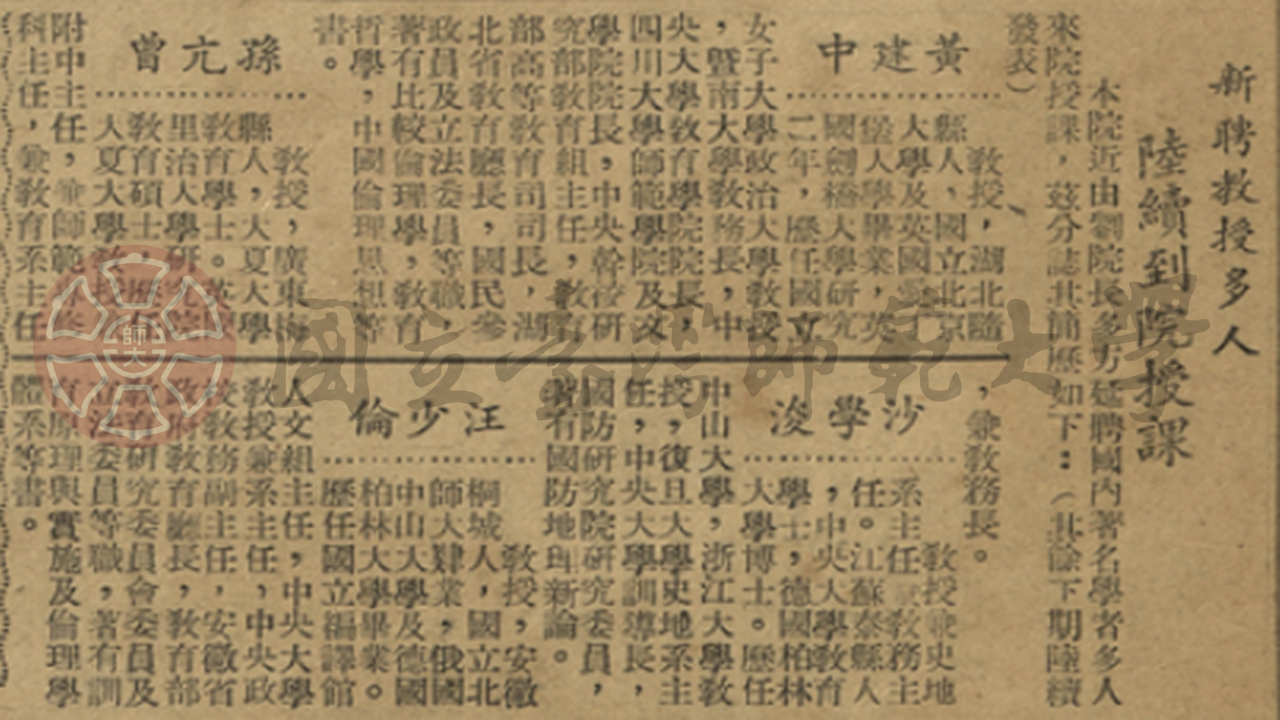
In its inaugural semester, the Taiwan Provincial Teachers College had 76 faculty members including Dean Lee Chi-Ku, who also served as a professor of history and geography. The majority of the faculty members, 41 in total, graduated from Chinese universities, while the other 24 graduated from universities overseas. In 1947, the number of faculty members increased to 103, including 67 graduates of domestic universities and 36 who had studied abroad. Among those with overseas education, the largest group—9 in total—had studied in Japan. Among them, Chen-Tsai Lien-Chang, Professor in the Department of Chinese and Director of Student Affairs, graduated from Tokyo University of Literature and Science (now University of Tsukuba) in Japan and returned to Taiwan in 1947 to teach at the Taiwan Provincial Teachers College. After Liu Chen succeeded as dean in 1949, he gradually invited scholars such as Sha Hsueh-Chuen, Liang Shih-Chiu, Huang Chun-Pi, Kuo Ting-Yi, Liao Chi-Chun, Ma Pai-Shui, Tien Pei-Lin, and Chen Ko-Chung to teach at the College, thereby strengthening the College's faculty lineup.
New Admissions
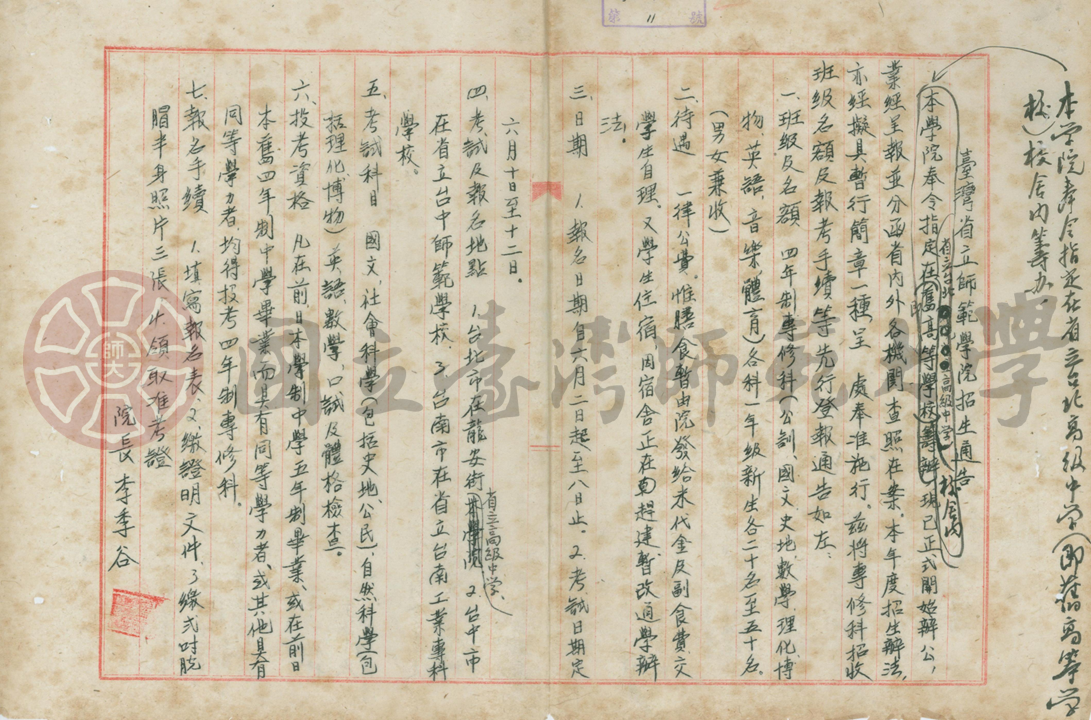
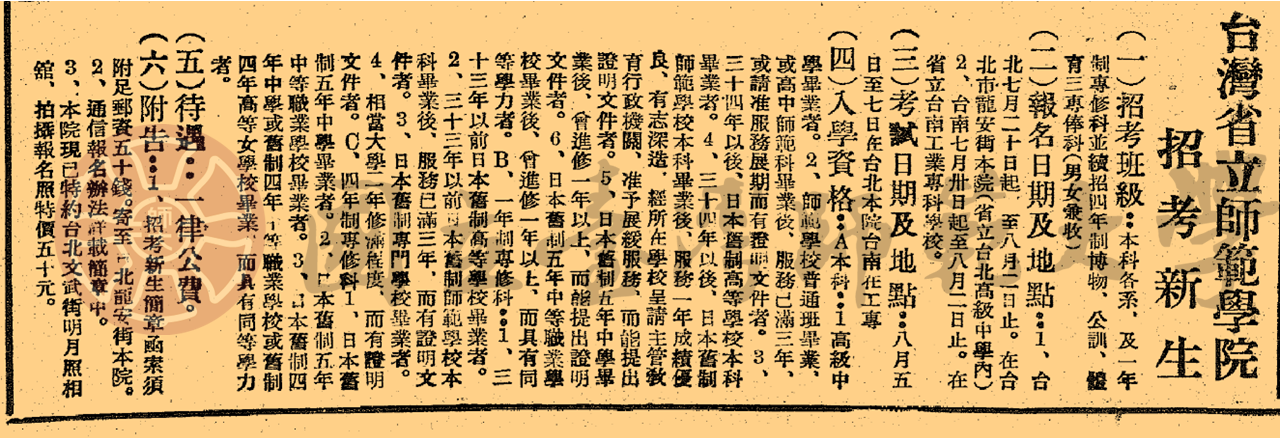
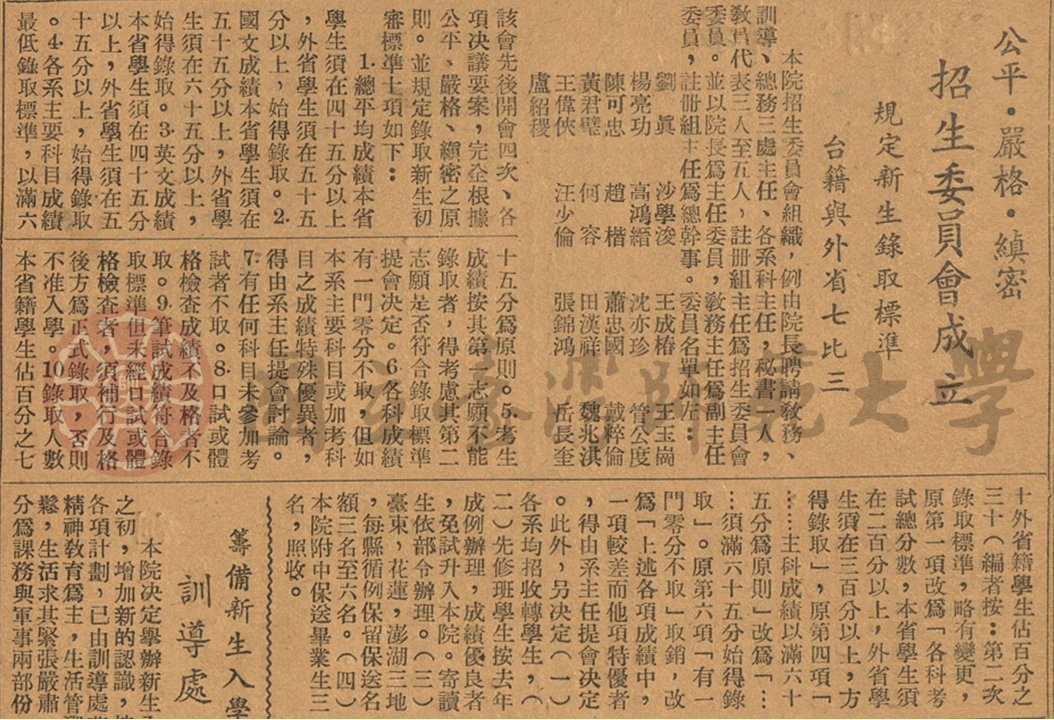
To meet the demand for secondary school teachers, a four-year specialized program was established and began admitting students in June 1946. In September of the same year, the seven departments described above were established, along with nine four-year specialized programs and a one-year specialized training course. The nine four-year specialized programs include the addition of physical education and music programs to the seven original departments, while the one-year specialized training course was offered without departmental specialization. The specialized training programs were established to meet the needs of the special circumstances of the time. The programs admitted graduates of the former Taihoku Higher School and applicants with equivalent qualifications.
According to the admissions standards established by the College's Admissions Committee, prospective students needed to pass a written examination, an oral interview, and a physical examination. For the written exam, a score of 65 or higher was required for admission. In the first semester, the College admitted a total of 484 students, of which 70% were Taiwanese locals, while 30% were from other provinces of China.
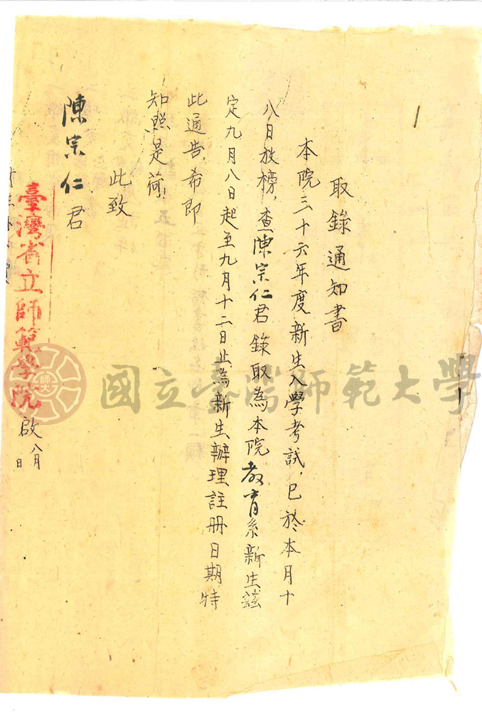
"Once I finished the exam, I stopped thinking about it. Well, one morning, while I was still asleep, someone knocked on my window, saying, 'Ah! Chin Ching-Yun! Chin Ching-Yun! You passed the exam! You made it!' Oh! I sprang out of bed. My sister and I hugged each other, spinning around the room in excitement. My sister exclaimed, 'Ah, we have finally done right by Mom and Dad!' I felt as though all the unhappiness and gloom of the past two years had been swept away. To say it in a fancier way, 'I felt as though I had been sailing through stormy seas in a battered boat and had suddenly reached land. Finally, the light of hope shines on my life.'"
—Chin Ching-Yun, who graduated from the Department of Music, Class of 1949, on gaining admittance to the College
Publicly Funded Benefits
Students of Taiwan Provincial Teachers College enjoyed publicly funded benefits such as full tuition waivers, as well as meals and accommodation, uniforms, and books provided by the government.
"When I was admitted to the Teacher's College, everyone lived on campus. Our food, lodging, bed sheets, clothes, and pocket money were all publicly funded... Since we were state-sponsored students, the school provided all our meals. When it was mealtime, everyone would line up with their bowls, wait for the student on kitchen duty to mark their meal tickets, and receive their food."
—Chen Ching-Jung, who graduated from the Department of Art, Class of 1952
"My mother wanted me to study at the Department of History of Tunghai University in Taichung. However, I considered our family's financial situation and realized that the expensive tuition of a private university like Tunghai was far beyond what my father's meager military salary could afford. So, I decided to stay in Taipei and study at the state-funded NTNU."
—Yang Yun-Yun, who graduated from the Department of History and Geography, Class of 1959
Internship
Internships are an essential part of teacher trainees' professional training, enabling them to gain experience in classroom instruction and learn the practical aspects of school administration.
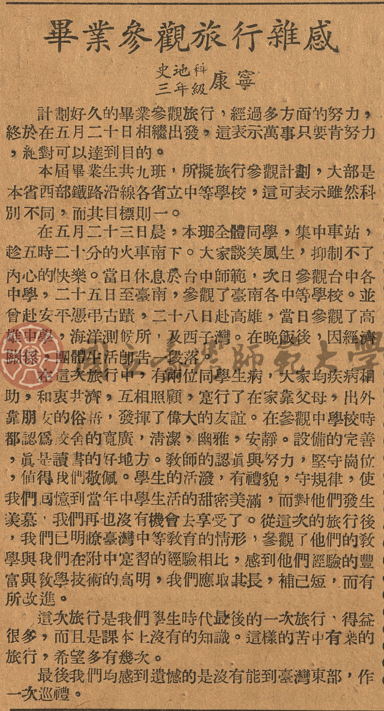
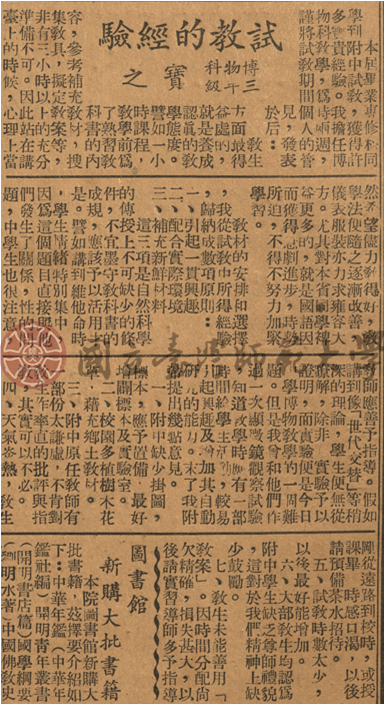
The 1949 issue of Taiwan Provincial Teachers College Journal included the "Outline of the Internship Program for Graduates of Taiwan Provincial Teachers College". This stated that internships consisted of school visits, observation, teaching practice, and administrative practice. "School visits" involved visits to schools, educational authorities, and social education institutions to better understand actual teaching and administrative practices. Both "observation" and "administrative observation" were conducted at the Provincial Department of Education and the Affiliated High School of the Teachers College (now the Affiliated Senior High School of NTNU), to provide teacher trainees with an opportunity to exchange views on their internship experiences ahead of trial teaching. "Teaching practice" involved trial teaching sessions carried out at the affiliated senior high school.
"We didn't have comfortable cars back then. After a long ride on the slow train, we had to walk to the school to observe classes, spending most of the day on our feet. At night, we slept in the classrooms. It might be hard for students today to believe, but I remember when we went to Tainan Teachers College, a dozen or so of us were crammed in a single wooden-floored classroom, with just a few blankets lent to us by the school."
—Huang Jin-Hong, who graduated from the Department of Chinese, Class of 1950, on off-campus teaching observation trips led by Professor Chang Wei-Ying
"I got a thorough understanding of just how rebellious yet endearing the students were during my senior year practice teaching at NTNU's Affiliated Senior High School. I couldn't find any chalk upon entering the classroom, the eraser was hidden on top of the blackboard, the lectern was constantly being moved around, and students rushed to ask questions, never hesitating to heckle or interrupt their teachers."
—Huang Yun-Yun, who graduated from the Department of History and Geography, Class of 1959
Graduation and Degree Conferment
Article 6 of the Regulations Governing Teacher Colleges stipulates that teacher trainees must complete four years of coursework, write a graduation thesis, pass the graduation examination, and complete a fifth year of internship to obtain a diploma and be awarded a bachelor's degree. Article 25 of the Academic Regulations of Taiwan Provincial Teachers College stipulates: "From their fourth year onwards, students of provincial teacher colleges must write a graduation thesis under the guidance of their department chair and thesis advisor. Only after their thesis passes review may they graduate." Article 26 stipulates: "Students who have completed the required courses and credits are permitted to take the graduation exam." The graduation exam, in turn, prescribes that "Students must take examinations in three major specialized subjects studied in the preceding years. Those who fail shall not be permitted to graduate."
After graduation, students of Taiwan Provincial Teachers College were required to remain at the schools where they had completed their internships to fulfill their obligated service corresponding to the number of years they received public funding as students. Article 26 of the Regulations Governing Teacher Colleges stipulates: "Graduates of teachers' colleges shall not engage in any position outside the field of education during the prescribed service period. Otherwise, they shall be required to repay all government-funded benefits received during their years of study. However, in special circumstances approved by the Ministry of Education, the service period may be postponed."